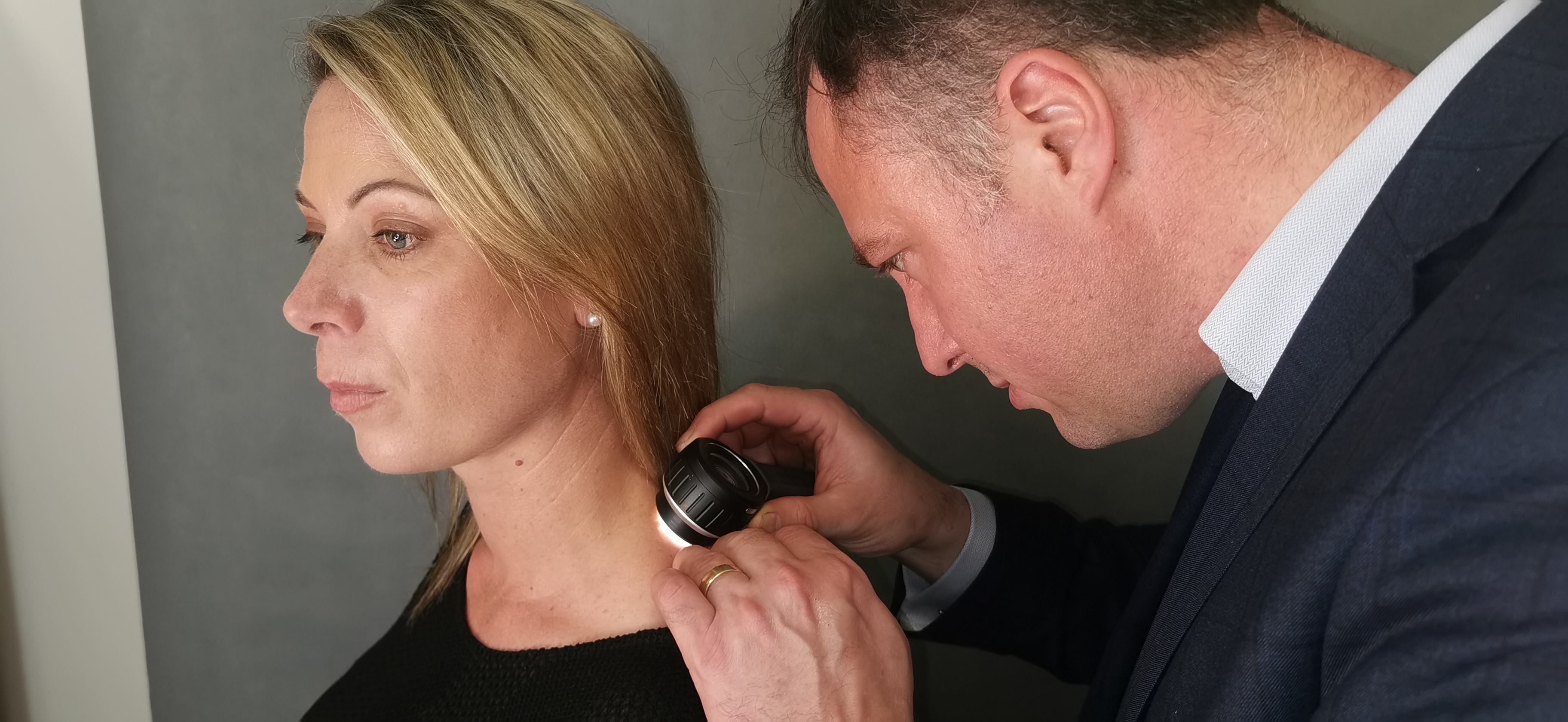



When a skin lesion is removed, two things matter: getting it all out, and closing the wound well. A plastic surgeon's training places particular emphasis on the repair — minimising scarring, preserving function, and choosing the right technique for the location. For lesions on the face, hands, or other high-visibility areas, this makes a significant difference.
Dr Yaprak performs skin cancer excisions and reconstructions as a core part of his practice. He sees patients with suspected and confirmed melanoma, BCC, SCC, Merkel cell carcinoma, and other skin lesions — as well as lipomas and benign lesions requiring removal.
Many procedures are performed in-rooms at Waikato Specialist Centre under local anaesthetic, as a straightforward day appointment. More complex cases, or those requiring general anaesthetic, are performed at Braemar Private Hospital.
Dr Yaprak performs the full range of skin cancer and lesion surgery — from simple excisions to complex reconstruction.

Excision of melanoma, BCC (basal cell carcinoma), SCC (squamous cell carcinoma), and Merkel cell carcinoma. Margins are planned to meet oncological requirements, and reconstruction is designed to minimise scarring and preserve function.

Removal of sebaceous cysts, lipomas, naevi, dermatofibromas, and other benign lesions. Most procedures are straightforward day appointments under local anaesthetic in Dr Yaprak's in-rooms theatre at Waikato Specialist Centre.

After larger excisions, reconstruction may use local flaps, skin grafts, or complex closure techniques to restore appearance and function. Dr Yaprak's plastic surgery training is particularly relevant here — wound closure is a specialist skill.
Dr Yaprak is a Southern Cross Affiliated Provider. Many skin surgery procedures are covered — but not all. Understanding the criteria before your consultation will help avoid surprises.
Southern Cross, UniMed, nib, Partners Life, AIA, and most other New Zealand health insurers are tightening their criteria for skin lesion and lipoma cover. Not all removals are covered — even with a good policy. The information below reflects current Southern Cross criteria, which other insurers are increasingly mirroring. Always check your own policy before assuming cover applies.
Southern Cross will reimburse skin lesion removal when at least one of these criteria is met:
For lipomas, Southern Cross will cover removal when:
Note: A medical report from Dr Yaprak is required for lipoma claims. Supporting documentation including photographic or radiological evidence must be retained.
Important: If you are unsure whether your lesion meets the criteria, please bring your policy details to your consultation. Dr Yaprak will advise whether your situation qualifies and assist with the documentation required for your claim. We cannot guarantee cover in advance — that determination rests with Southern Cross.
Skin cancer excision involves removing the lesion along with a margin of surrounding normal tissue. The margin size depends on the type and stage of the cancer — Dr Yaprak follows current New Zealand and international guidelines for each lesion type.
After excision, the wound is closed using the most appropriate technique for that location — direct closure, a local flap, or a skin graft. On the face or hands, the choice of closure matters enormously for both function and appearance.
The excised tissue is sent to a pathologist to confirm the diagnosis and check that margins are clear. Dr Yaprak reviews all pathology results with patients and discusses next steps where required.
If you're concerned about a skin lesion, the first step is to see your GP. Your GP can assess the lesion and refer you to Dr Yaprak if they are concerned. This is the normal process — and importantly, most health insurers require a GP referral for cover to apply. Without a referral, your insurer may decline the claim even if the lesion meets their clinical criteria.
In many cases, where we have sufficient information from your GP referral and the lesion is suitable, we can perform the consultation and excision on the same day. This saves you a second visit and means the lesion is dealt with promptly.
If you would like a same-day procedure, please let us know when you book. To make this possible we need your GP referral and any relevant history in advance. There are also a few important things to tell us before your appointment:
For melanomas of appropriate thickness, sentinel lymph node biopsy may be required to assess whether cancer cells have spread. Dr Yaprak performs this procedure at Braemar Private Hospital.
Skin lesion removal pricing depends on three main factors:
If you'd like an idea of likely cost before booking, please contact us with details of the lesion and its location and we'll give you a general guide. A formal all-inclusive written quote is provided at your consultation.
Pricing for skin lesion surgery varies depending on the size and location of the lesion, and the type of closure required. We are happy to give you a general guide before you book — please contact us or call 07 838 8984 with details of your lesion and we'll help you understand what to expect. A formal all-inclusive written quote is provided at your consultation.
If you're concerned about a skin lesion, start with your GP. They can assess it and refer you to Dr Yaprak if warranted. A GP referral supports your insurance claim and ensures Dr Yaprak has the clinical history needed to plan your care.
Dr Yaprak examines the lesion, discusses the diagnosis and your options, and provides a written all-inclusive quote. Where suitable, consultation and excision can happen on the same visit — let us know when booking if you'd prefer this.
Most excisions are performed under local anaesthetic in-rooms at Waikato Specialist Centre. The procedure typically takes 30–60 minutes and you go home the same day. Complex cases are performed at Braemar Private Hospital.
Tissue is sent to a pathologist. Results are typically available within 1–2 weeks. Dr Yaprak or the nursing team will contact you to discuss results and any further steps required.
Sutures are removed 7–14 days after surgery — facial sutures at 7 days, body sutures at 10–14 days. Follow-up care is included. For melanoma cases, ongoing surveillance is coordinated with your GP.
Reconstruction after skin cancer removal is a plastic surgery specialty — the repair matters as much as the excision
Simple cases managed in-rooms under local anaesthetic. Complex cases at Braemar Private Hospital with full surgical team
Affiliated Provider status means eligible procedures may be covered. Dr Yaprak provides the documentation required for claims
90 minutes from Auckland. Free on-site parking. Prompt appointments for skin cancer — we understand urgency matters
Don't wait. Skin cancers caught early are almost always treatable. Book a consultation with Dr Yaprak — we see skin cancer patients promptly.
Book a Consultation