
How to choose a plastic surgeon in New Zealand — a patient’s guide to credentials, training and safety
Choosing a plastic surgeon is one of the most significant decisions you’ll make about your health. In New Zealand, the credential landscape can be confusing — not all practitioners who advertise cosmetic surgery are equally trained. This guide explains what the credentials actually mean, what questions to ask, and how to make a properly informed choice.
Why credentials matter more than you might think
When people search for “the best plastic surgeon in New Zealand,” what they’re really asking is: how do I know this person is properly qualified and safe? That’s the right question — and the answer comes down to understanding what the letters after a surgeon’s name actually mean.
In New Zealand, the title “plastic surgeon” is a protected designation. To use it, a doctor must hold a recognised specialist qualification in plastic and reconstructive surgery and be vocationally registered with the Medical Council of New Zealand (MCNZ). This requires a minimum of 12 years of total medical and surgical education, including at least five years of specialist postgraduate training.
“Cosmetic surgeon,” by contrast, is not a protected title in New Zealand. Any registered doctor can call themselves a cosmetic surgeon, regardless of their surgical training or experience. This distinction is important — and it’s one that is not always obvious to patients researching online.
Important: Before booking any cosmetic or surgical procedure, check that your surgeon holds specialist registration in plastic and reconstructive surgery with the Medical Council of New Zealand. You can verify this at mcnz.org.nz. Membership of NZAPS is also a strong signal — you can search the member list at plasticsurgery.org.nz.
Understanding the credentials — what each one means
Here is a plain-language guide to the main credentials and memberships you’ll see listed by specialist plastic surgeons in New Zealand.
Fellow of the Royal Australasian College of Surgeons — Plastic Surgery
The benchmark qualification for specialist plastic surgeons in Australia and New Zealand, recognised by MCNZ. Requires completion of a competitive five-year postgraduate training programme in plastic and reconstructive surgery, plus comprehensive examinations. The gold standard NZ/Australian pathway.
Fellow of the European Board of Plastic, Reconstructive and Aesthetic Surgery
The European equivalent of board certification in plastic surgery. Awarded by the European Board of Plastic Reconstructive and Aesthetic Surgery (EBOPRAS) after rigorous written and oral examinations. Recognised by MCNZ as substantially equivalent to FRACS. Held by surgeons who trained in Europe under national specialist programmes.
New Zealand Association of Plastic Surgeons
The peak professional body for specialist plastic surgeons in New Zealand. Membership requires FRACS or an equivalent qualification recognised by MCNZ, plus full vocational registration. NZAPS members must comply with strict ethical guidelines and professional conduct standards. Checking the NZAPS member list is one of the simplest ways to verify a surgeon’s specialist status.
Australia and New Zealand Board of Certified Plastic Surgeons
A new certification established in January 2025, specifically created to help patients identify qualified specialist plastic surgeons in the face of growing public confusion about cosmetic surgery credentials. Board Certification is renewed annually and requires ongoing cosmetic surgery-specific continuing professional development. See below for more detail on why this was set up.
Australasian Society of Aesthetic Plastic Surgeons
The peak aesthetic (cosmetic) plastic surgery society for Australia and New Zealand. Membership is open only to specialist plastic surgeons with FRACS or equivalent, who have demonstrated a significant focus on aesthetic surgery. Membership signals specific expertise and commitment to cosmetic surgery standards.
International Society of Aesthetic Plastic Surgery
The leading international professional organisation for aesthetic plastic surgeons. Members must be certified specialist plastic surgeons in their home country. ISAPS membership signals engagement with the global plastic surgery community and access to international training and education.
The ANZBCPS — why it was created and what it means
The Australia and New Zealand Board of Certified Plastic Surgeons (ANZBCPS) is brand new — it was established in January 2025 specifically in response to growing patient confusion about who is and isn’t a qualified surgeon in the cosmetic space.
A January 2025 survey conducted by ANZBCPS found that 58% of patients had difficulty identifying the right surgeon, and 44% expressed mistrust in online information about cosmetic surgery credentials. The board was created directly to address this.
ANZBCPS Board Certification is available only to specialist plastic surgeons who meet all of the following criteria:
- Completed accredited specialist surgical training (FRACS or equivalent recognised by MCNZ or AHPRA)
- Currently registered as a specialist plastic surgeon with MCNZ or AHPRA
- Member in good standing of NZAPS, ASAPS, or ASPS
- Currently active in cosmetic plastic surgery practice
- Compliant with ongoing cosmetic surgery-specific continuing professional development (CPD)
Certification is renewed annually — so it’s not a qualification earned once and forgotten. A surgeon displaying the ANZBCPS Board Certified logo has confirmed their specialist status, active practice, and ongoing education every year.
You can verify ANZBCPS certification at boardcertified.org.au — the official searchable register of board certified cosmetic plastic surgeons in Australia and New Zealand.
The difference between a specialist plastic surgeon and a cosmetic doctor
This is the question that matters most — and the one that causes the most confusion.
| Criterion | Specialist Plastic Surgeon | Cosmetic Doctor |
|---|---|---|
| Training | Minimum 12 years total medical and surgical education, including 5+ years specialist plastic surgery training | Varies widely — may have no formal surgical training beyond basic medical degree |
| Title protection | “Plastic surgeon” is a protected title in NZ — cannot be used without MCNZ specialist registration | “Cosmetic surgeon” is not a protected title — any doctor can use it |
| MCNZ registration | ✓ Vocationally registered as specialist in plastic and reconstructive surgery | ✗ Not required to hold specialist registration |
| NZAPS membership | ✓ Eligible — requires FRACS or equivalent | ✗ Not eligible |
| Surgical training scope | Trained to perform full range of surgical procedures — reconstructive, trauma, burns, hand, cosmetic | May be limited to non-surgical or minimally invasive procedures only |
| Hospital privileges | Credentialled to operate at accredited private hospitals | May not hold hospital operating privileges |
What to ask before booking a consultation
Beyond credentials, there are practical questions every patient should ask — either before booking or at the consultation itself.
- ✓Is the surgeon vocationally registered as a specialist plastic surgeon with the Medical Council of New Zealand?
- ✓Are they a member of NZAPS? (Verify at plasticsurgery.org.nz)
- ✓Are they ANZBCPS Board Certified? (Verify at boardcertified.org.au)
- ✓Where is surgery performed — at an accredited private hospital or in a day surgery clinic?
- ✓Is the quote all-inclusive — does it cover hospital, anaesthetist, nursing, consumables, and follow-up?
- ✓How many consultations are required before surgery — and are they face-to-face?
- ✓What is the surgeon’s specific experience with the procedure you’re considering?
- ✓What is the follow-up process — and is it included in the quote?
Why ongoing training matters as much as qualifications
Surgical techniques evolve. A surgeon’s initial qualification matters — but so does what they’ve done since. The best plastic surgeons invest continuously in refining their skills through observerships, international conferences, and peer collaboration.
When evaluating a surgeon, look for evidence of ongoing engagement with their specialty: attendance at national and international conferences, observerships with leading surgeons, and active membership in professional societies that require continuing education.
This is particularly relevant for facial surgery, where techniques have advanced significantly over the past decade, and for breast surgery, where implant technology and surgical approaches continue to evolve.
The consultation — what a good one looks like
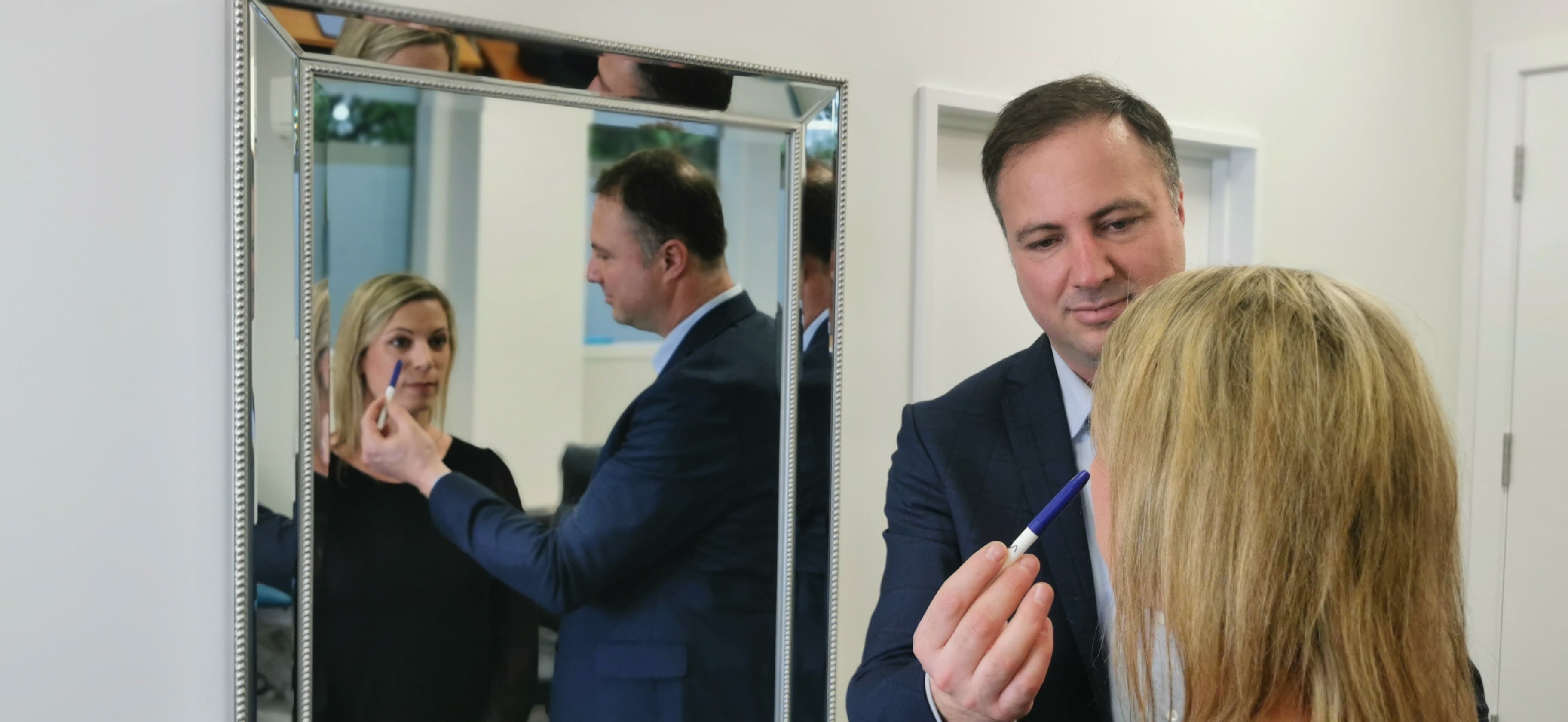
A consultation with a specialist plastic surgeon is a clinical assessment — not a sales appointment. A good consultation will:
- Take time. A proper consultation is 30–45 minutes minimum. If you feel rushed, that’s a signal.
- Be honest. A good surgeon will tell you if a procedure isn’t appropriate for your anatomy or goals — and explain why.
- Be in person. For surgical procedures, a face-to-face assessment is essential. Anatomy cannot be properly assessed remotely.
- Result in a written quote. You should leave with a clear, all-inclusive written quote — not a verbal ballpark figure.
- Not pressure you. NZAPS guidelines require a minimum two-week period between consultation and surgery. Any surgeon pushing for immediate commitment should be a red flag.
Under NZAPS guidelines, a minimum of two weeks must pass between your consultation and any surgery. Two face-to-face consultations are required before proceeding with facial surgery and neck lift procedures. This exists to protect you — it gives you time to make a properly informed, considered decision.
About Dr Bülent Yaprak — credentials and training
Dr Yaprak is a specialist plastic, reconstructive and hand surgeon based at Waikato Specialist Centre in Hamilton. His credentials include:
- FEBOPRAS — Fellow of the European Board of Plastic, Reconstructive and Aesthetic Surgery, awarded after rigorous written and oral examinations. Recognised by MCNZ as equivalent to FRACS.
- NZAPS — Member of the New Zealand Association of Plastic Surgeons
- ANZBCPS — Board Certified by the Australia and New Zealand Board of Certified Plastic Surgeons (2025)
- ASAPS — Member of the Australasian Society of Aesthetic Plastic Surgeons
- ISAPS — Member of the International Society of Aesthetic Plastic Surgery
Dr Yaprak trained at Istanbul University Medical Faculty — one of Turkey’s most prestigious plastic surgery programmes — before moving to New Zealand, where he worked as a consultant plastic surgeon at Waikato Hospital for over a decade. He has attended more than 40 international conferences and completed observerships with leading surgeons in Istanbul, Paris, Washington, Louisville, and El Paso.
Surgery is performed at Braemar Private Hospital (for general anaesthetic procedures) and at Waikato Specialist Centre (for local anaesthetic procedures). All quotes are all-inclusive — surgeon, anaesthetist, hospital, nursing, consumables, and six weeks of follow-up.
Dr Yaprak sees patients from Hamilton, Auckland, Tauranga, and across the North Island.

Book a consultation in Hamilton
Initial consultation $267. Face-to-face clinical assessment with a FEBOPRAS and NZAPS specialist plastic surgeon. Patients welcome from Auckland, Tauranga, and across New Zealand.
Request a Consultation